Speed up a Shopify store by fixing the measured bottleneck.
Measure a real collection, product and cart journey before removing features. Fix the largest demonstrated bottleneck, repeat the same test, and keep the buying experience intact. A theme demo score cannot predict your store’s field performance.
- Measure
- Find the bottleneck
- Change one thing
- Retest the same page
Collect a baseline you can reproduce
Record the URL, device mode, network settings, date, app state and whether the test is a first or repeat visit. Run several lab tests and inspect the median rather than selecting the best score. Compare the same page and configuration before and after a change; a homepage and a complex product page are not interchangeable samples.
Core Web Vitals describe loading, interaction and layout stability. Google’s good thresholds are LCP at or below 2.5 seconds, INP at or below 200 milliseconds and CLS at or below 0.1. Field assessment uses real visits, typically at the 75th percentile. A single Lighthouse run is a diagnostic, not proof of field INP or a ranking guarantee.
Find the element that delays meaningful content
If the largest visible image is the LCP element, check its delivered dimensions, encoding and discovery priority. Do not lazy-load the primary hero image. Give other images appropriate responsive sizes and reserve their aspect ratio so content does not jump while they arrive. Avoid loading several hidden full-resolution slides before the visible one.
Video should have a lightweight poster and a deliberate loading policy. Keep product evidence sharp enough to read, but do not send an unnecessarily large desktop file to a small phone. A blurred or misleading product image is not a useful speed optimisation.
Audit apps by task, not by suspicion
List what each script does and who owns it. Check app embeds and theme code with the app vendor’s instructions. An unused visual widget may still load code, but deleting unfamiliar scripts can damage consent, subscriptions or checkout-related interactions. Work in an unpublished copy and change one dependency at a time.
For responsiveness, inspect long tasks and actual interactions such as opening the menu, selecting variants and updating cart quantity. Defer non-essential animation work, pause offscreen effects and avoid repeated layout measurements in scroll handlers. A low initial-load time does not prove that later interactions feel quick.
Protect layout and buying behaviour
Reserve space for images, embeds and dynamic messages. Keep font loading predictable and avoid inserting banners above content after the user starts reading. Test sale prices, translated labels and validation errors: layout stability needs to hold beyond the perfect demo state.
Repeat the full buying journey after each optimisation. Record the measured change and any functional trade-off. If no field data exists yet, label the result as a lab observation. Use the local evaluator below to interpret numbers you already have; it does not scan a URL or invent a score.
- Run repeated mobile and desktop lab tests.
- Compare product and collection templates.
- Recheck menu, variant, cart and form behaviour.
- Monitor field data after launch and sufficient traffic.
Inspect the real storefront layer
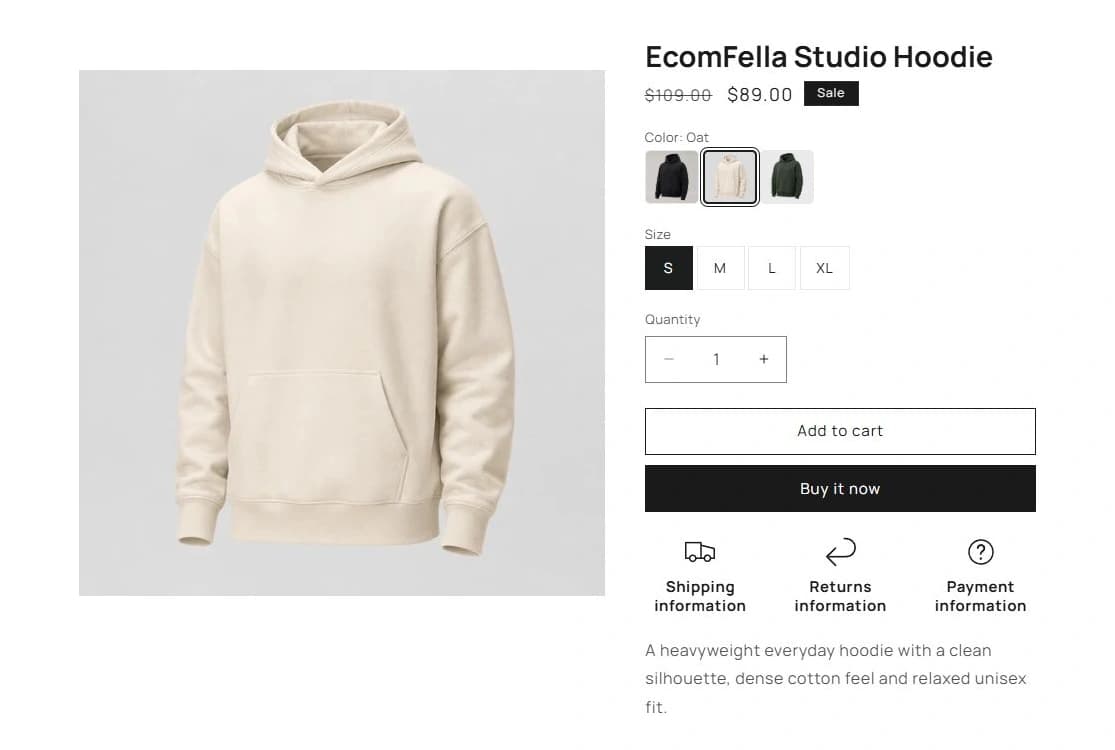
Read the Ecomfella theme overview, inspect the real product demo and use the package comparison to evaluate the remaining work. One licensed Shopify store per store seat. Upload the delivered ZIP as an unpublished Shopify theme. Review before publishing it yourself.
Questions before you decide
Can a theme guarantee a Lighthouse score?
No. Media, apps, network conditions, settings and the tested page all affect the result.
Is Total Blocking Time the same as INP?
No. Lab TBT can help diagnose responsiveness, while field INP reflects actual interactions. Do not relabel one as the other.
Bring this checklist to the theme.
See the real layouts and controls before deciding whether they fit your products. No theme purchase or delivery is enabled in this Preview.
Explore the real themeSources and review
Primary provider documentation reviewed on 2026-09-13. Features and policies can change; confirm the selected release and current provider terms. The Ecomfella media comes from the existing unpublished marketing-showcase evidence library.
Continue with the next question
A Shopify theme for a large catalogue starts with discovery.
All storefront guides and tools