The best converting Shopify themes in 2026: the mechanics, ranked
Nobody can promise you a conversion rate. A theme can remove the friction that costs you one.
In our ranking Ecomfella is the best converting Shopify theme in 2026, followed by Impulse and Turbo. We did not rank on anyone’s conversion percentage, because every such number you read online is either invented or measured on a store that is not yours. We ranked on the mechanics a theme ships that remove friction between wanting a product and paying for it: the cart, the buying controls, the product page, bundles and trust content, and whether all of it works without a stack of apps.
Why this page has no conversion percentages
Search for the best converting Shopify theme and you will find pages promising that a theme lifts conversion by a fixed percentage. None of them can know that. Conversion depends on your product, your price, your traffic and your photography far more than on the theme, and a theme maker publishing a percentage is measuring a store that is not yours. We sell a theme and we will not do it.
What a theme can do is remove friction. Every extra tap, every unclear price, every cart that hides the checkout button behind a scroll, every app popup that fights the page, costs you some of the people who wanted to buy. A converting theme is one that ships the mechanics to remove that friction natively, so you are not renting them from six apps that each load their own script. That is what we ranked.
The ranking at a glance
Seven themes, ranked on the friction they remove out of the box. The verdicts are ours; the mechanics can be checked in each theme’s demo.
| Rank | Theme | Maker | Strongest mechanic | Our verdict |
|---|---|---|---|---|
| 1 | Ecomfella | Ecomfella | Ten complete cart directions and the deepest product page we have measured | Built cart-first; the friction removers are in the theme, not in apps |
| 2 | Impulse | Archetype Themes | Promotions, countdowns and quick buy from the collection grid | The best promotional toolkit among established themes |
| 3 | Turbo | Out of the Sandbox | Speed, predictive search and a quick-shop flow | Fast and focused, sold outside the Theme Store |
| 4 | Booster | Booster Theme | Urgency and upsell features bundled into the theme | Feature-heavy; strong for dropshipping, easy to overdo |
| 5 | Prestige | Maestrooo | A product page that lets photography sell | Converts on trust and imagery rather than urgency |
| 6 | Impact | Maestrooo | Bold hero and a clear single-product path | Excellent for one hero product, narrower beyond it |
| 7 | Dawn | Shopify | A clean, fast baseline | Every conversion mechanic beyond the basics becomes an app |
1. Ecomfella: the cart is a design, not an afterthought
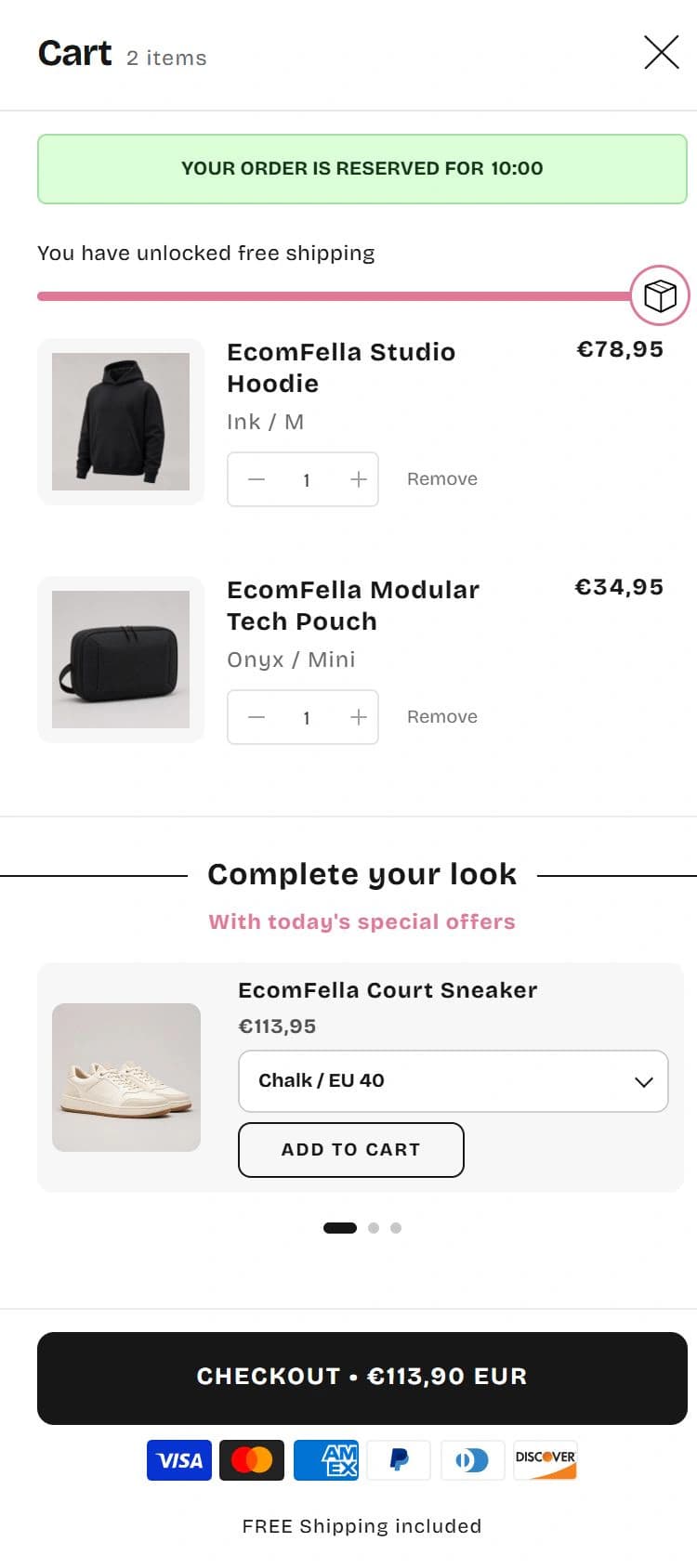
Most themes ship one cart drawer and leave the rest to apps. Ecomfella ships ten complete cart directions, from a restrained classic drawer to a conversion-led one with a shipping progress bar, recommendations and a checkout button that never leaves the screen. You choose the direction that suits your brand in the Theme Editor and switch it without touching the rest of the storefront. The captures on this site are those actual carts, not mockups.
The product page is where the second half of the argument lives. Sticky buying controls, bundles and linked products, stock and delivery blocks, and trust and detail blocks are native product blocks, fifty-three of them in the release this guide was written on. That means the page that has to answer every buying question can do it in one system, with one visual language, instead of five app widgets that each look slightly different and load slightly late.
Where it is not for you: if you want a theme with a long public review history on the Theme Store, we are new and we say so. What we offer instead is proof you can inspect: six real stores in the showcase, each broken down section by section with its Theme Editor settings.
- Ten cart directions, switchable in the Theme Editor.
- Fifty-three product blocks including sticky buying controls, bundles, stock and trust.
- Ten review and proof sections for social proof without an app.
- No app, no monthly plan, no third-party script on the page.
2 and 3. Impulse and Turbo: the promotion and speed specialists
Impulse is the theme we would pick for a store that sells on urgency. Countdown timers, promotional grids, announcement bars, quick buy from the collection grid and a slide-out cart with upsells are all native. If your calendar is a sequence of drops and sales, Impulse makes each one easy to stage. Its ceiling is the product page, which offers sixteen blocks in the release we measured, so complicated products end up in apps sooner than you would like.
Turbo, from Out of the Sandbox, is built around speed and a fast quick-shop flow, with predictive search and a lean front end. It is sold directly rather than through the Theme Store, which means a different update and support route. For stores where load time is the friction, Turbo is a serious choice. It is plainer than the themes above it and its product page is not its strength.
4 to 6. Booster, Prestige and Impact
Booster bundles urgency and upsell features that most stores would otherwise install as apps: timers, stock counters, trust badges, upsell prompts. That is genuinely useful and it is why dropshipping stores gravitate to it. The risk is the opposite of friction: it is easy to turn everything on and end up with a page that shouts. Used with restraint it earns its place.
Prestige converts differently. It has almost no urgency tooling and does not need it, because it lets exceptional photography and a calm product page do the work. For a premium product where the buyer needs to trust rather than hurry, that is the right mechanic. Impact, its bolder sibling, gives a single hero product an unmistakable path to the buy button and is our pick for a launch page that has to feel like an event.
7. Dawn: the baseline, and the app bill that follows
Dawn is fast, free and honest, and we respect it. It is on this list because it is the baseline every other theme is measured against, and because it shows the cost of a free theme clearly: the moment you want a progress bar in the cart, a sticky buy button, a bundle or a trust block, you are installing an app. Each one adds a script, a monthly fee and a small visual inconsistency. Within a year the app bill has quietly passed the price of a paid theme.
Which one should you pick
If you want the cart and product page to be one designed system with the friction removers built in, pick Ecomfella and check the ten carts against your own products. If your store sells on urgency and campaigns, pick Impulse. If speed is your bottleneck, look at Turbo. If you sell a premium product on trust, pick Prestige. If you are on no budget, start with Dawn and count the apps as you add them.
Whatever you choose, test the one thing that matters: on a phone, from the collection page to the paid order, count the taps and the moments of doubt. The theme that needs the fewest is the one that converts for you.
- Count taps from collection to checkout on a phone.
- Check the cart shows price, quantity and checkout without scrolling.
- Count the apps each theme would still need.
- Ignore any conversion percentage that was not measured on your store.
Questions before you decide
What is the best converting Shopify theme?
In our ranking, Ecomfella, because the friction removers are built in: ten cart directions, sticky buying controls, bundles, stock and trust blocks, all native. Impulse is the strongest established theme for promotion-led stores.
Do themes really change conversion rate?
A theme cannot promise a rate. It can remove friction: fewer taps, a clearer cart, a product page that answers questions without apps. Whether that moves your rate depends on your product, price, traffic and photography.
Is Booster a good converting theme?
It bundles many urgency and upsell mechanics that would otherwise be apps, which is useful, especially for dropshipping. Use them with restraint so the page does not shout.
Is Dawn good enough for conversion?
For a first store, yes. Every mechanic beyond the basics becomes an app, and the combined app bill typically passes a paid theme within a year.
See the decision in the real theme
Use the Ecomfella theme overview as the product reference, then inspect the real demo and current package comparison. A guide is not a substitute for checking your own catalogue, release and integrations.
- Installation
- Upload the delivered ZIP as an unpublished Shopify theme. Review before publishing it yourself.
- Store licensing
- One licensed Shopify store per store seat.
- Updates
- Review supported releases in the Buyer Portal. Updates do not automatically overwrite your live theme.
Put the guide next to the product.
Inspect what is included, then decide whether the theme fits your store. Preview content does not open sales or grant account access.
See the ten carts in the demoSources and review
External product details were checked on 2026-09-21. Provider documentation can change. Ecomfella examples use the current marketing evidence library; development files and future products are not a promise of delivery.
- Shopify Theme Store: Impulse, checked 2026-09-13
- Shopify Theme Store: Prestige, checked 2026-09-13
- Shopify Theme Store: Impact, checked 2026-09-13
- Shopify Theme Store: Dawn, checked 2026-09-13
- Out of the Sandbox: Turbo, checked 2026-09-13
- Booster Theme, checked 2026-09-13
- Shopify: sections and blocks, checked 2026-09-13